News

5 highlights from International Fundraising Congress 2023
Written by Georgina Oxlade, Associate Director of Operations, Remarkable Partnerships.

International Fundraising Congress (IFC) 2023 was inspirational. The theme for 2023 was Unite. We truly felt this theme throughout the conference – from the topics covered to the opportunity to network. 

Remarkable Partnerships had the pleasure of delivering two workshops during the conference, as well as attending sessions delivered by others. So we are sharing our five highlights from IFC 2023.

Momentum = mass x velocity 

Erica Chenoweth, Academic Dean at Harvard Kennedy School gave a fascinating keynote speech.  They and their team have been researching the factors which enable movements or campaigns to succeed. 

The findings had one penny drop moment for us. Erica described how we can use an insight from physics to help us deliver successful campaigns. Physics tells us that momentum = mass x velocity. Their research shows that the success of social movements increases as they gain momentum. Momentum in this instance is created through participation (mass) combined with the number of events (velocity).

So, if you want to build momentum for your campaign, consider how mass x velocity can help you achieve your goals. 

ESG is huge

We attended a thought-provoking workshop on ESG (environmental, social, governance).  

Companies are increasingly recognising that their impact needs to be measured in ways beyond their bottom line. Although ESG can be seen as tool to measure sustainability, we also see that it is an ethos that can companies follow, so they are more successful because they make a positive impact. 

Our most important take away is that ESG is a HUGE opportunity for charities to speak to corporate prospects and partners about how their partnership can help the company deliver their ESG goals.

This is the dawn of a new era - ESG is HUGE – and it is shaping the future of business.

We all need a lift

What the conference really highlights is that by getting together in person really does energise fundraisers. Being together means we can bounce ideas off of each other, learn from others, and build valuable connections.

The session delivered by Kristian A Aloma and Madeline Duran revealed that 50% of fundraisers leave their jobs after 2 years. Their evidence showed that the main reason for leaving a job is often the conflict between why we join the charity sector, (to do meaningful work), and the reality, that it is exhausting. 

Times are tough, and sometimes the role of a fundraiser is lonely and exhausting. Building connections with your peers is essential to enable you to realise that what you are doing is  incredible. It lifts you up. 

Shared purpose is the key

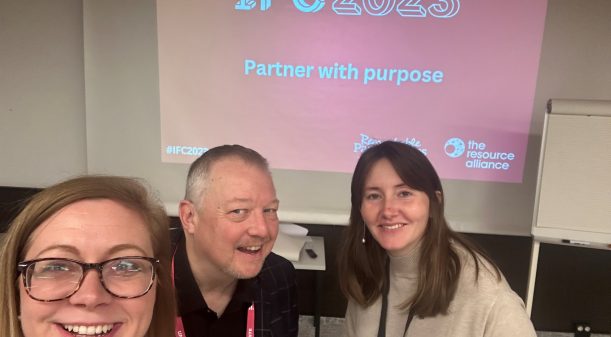
We delivered a workshop on ‘Partner with purpose’. During our session we shared that in tough times business leaders increase their focus on their core business priorities. This is an opportunity for charities.

In these challenging times, companies are still interested in opportunities, but they must deliver commercial benefits for the company. So we recommend you pitch them opportunities. A powerful pitch should include the big reason WHY you and that company should partner – we call this ‘Shared purpose’. 

Participants in our workshops discovered their unique shared purpose with a corporate partner or prospect.

If you would like to discover how shared purpose can help you win new partnerships, or grow existing ones, then please get in touch by sending me an email at georgina@remarkablepartnerships.com

Uniting makes bigger possible 

This year’s theme of unite was more meaningful than ever before. In a world filled with challenges such as the climate crisis, war and unstable economic conditions, uniting is vital for progress. 

Speakers throughout the conference showed us that when people come together, we can achieve something greater.

The groundbreaking speeches by young climate activists Nyombi Morris, Topaz Zega, and Phoebe Hanson left us feeling positive for the future, despite the challenges the world faces. They showed us that small actions can create real change. Unity truly does make bigger possible. 

Conclusion 

Our highlights cannot do justice to our experience of IFC. We learned so much, and our cups are truly topped up with inspiration and enthusiasm to do what we do.  

If you enjoyed this blog you might be interested in attending one of our upcoming training courses where we share our most valuable insight and tools. Use this link to see our choice of training courses over the next 12 months: https://www.remarkablepartnerships.com/training

Book Your Discovery Call

Let’s build partnerships that your cause — and the world — actually needs.

Book A Discovery Call
Latest News
5
min read
How Healthy is Your Pipeline?

When doctors and nurses need to understand how healthy a patient is, they start by checking the vital signs: blood pressure, temperature, and heart rate. These simple checks can quickly tell them whether everything is working as it should or whether something needs attention.

So, when we meet with charities, we often want to follow a similar process with their corporate partnerships. One of the questions we always ask is: how healthy is your pipeline?

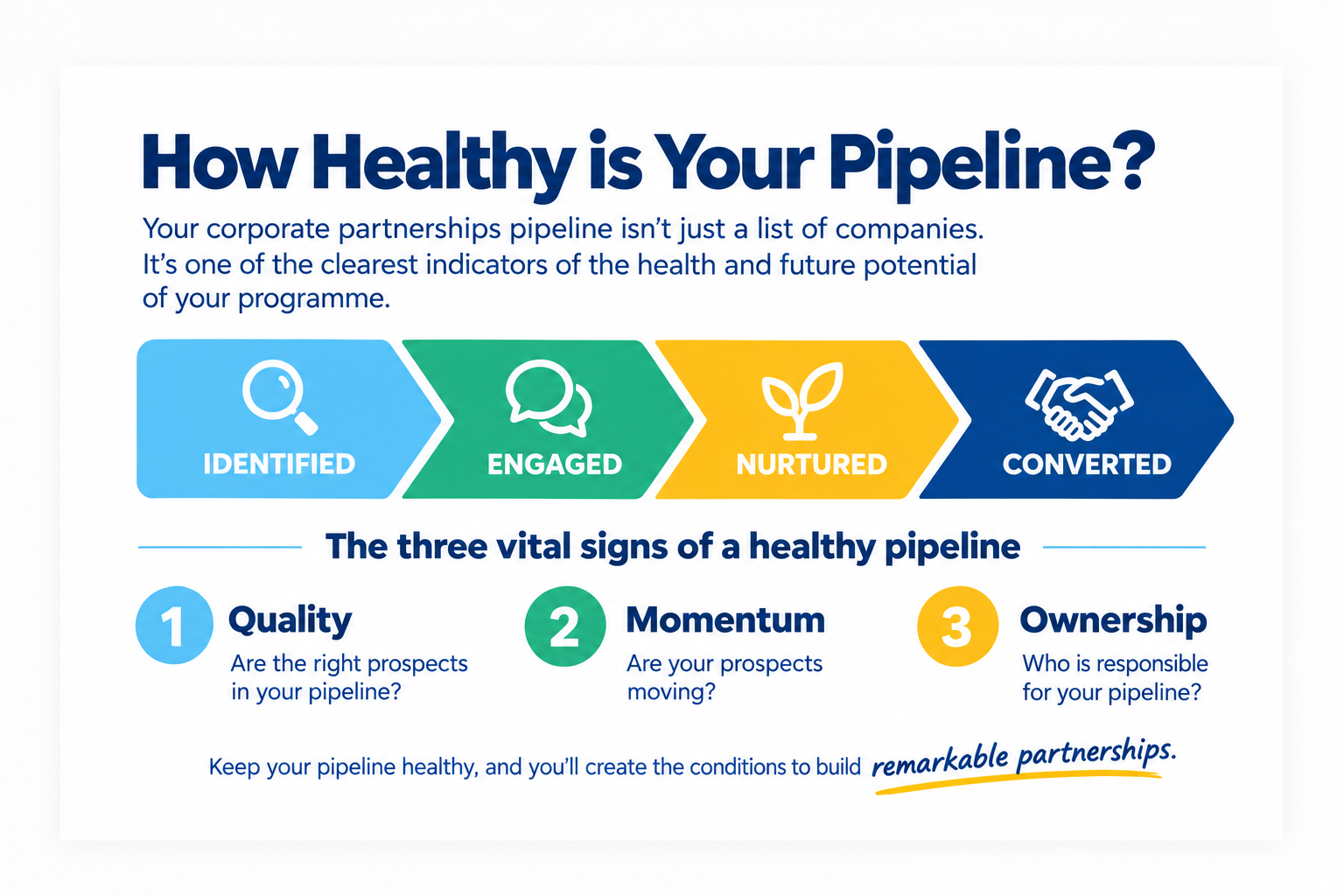
The answer is often incredibly revealing, because your pipeline isn't simply a list of companies you'd like to work with; it's one of the clearest indicators of the health and future potential of your corporate partnerships programme.

So, if you were giving your pipeline a health check today, what would you find?

The three vital signs of a healthy pipeline

We believe three key factors matter: quality, momentum, and ownership.

1. Quality: Are the right prospects in your pipeline?

A big pipeline isn't necessarily a healthy pipeline. You could have 100 companies listed, but if most have little connection to your cause, limited potential, or no realistic route to engagement, what value does that number really give you? 

A healthy pipeline includes quality prospects: companies with high-value potential that fit your organisation and its purpose, so you need to be selective.

Ask yourself: Are these genuinely the companies we should be investing our time and energy in?

Sometimes, improving the health of your pipeline isn't about adding more prospects; it's about being brave enough to remove the wrong ones.

2. Momentum: Are your prospects moving?

A healthy pipeline should never be static. Your prospects should be consistently moving through the different stages of your pipeline, from identified to engaged, nurtured and, ultimately, converted.

Of course, that doesn't mean every prospect will move at the same speed. Building high-value corporate partnerships takes time, but it should still build momentum. If a company has been sitting in the same stage for six months, ask why.

  • What's stopping it from moving forward?
  • What conversation needs to happen?
  • Who else could you involve?
  • What's the next action?
  • And if there isn't a realistic next action, should that prospect still be taking up space in your pipeline?

Successful corporate partnerships teams don't just track activity; they actively look for ways to create momentum.

3. Ownership: Who is responsible for your pipeline?

Your pipeline shouldn't live forgotten in a spreadsheet that gets opened once a month; it needs ownership.

The most successful corporate partnerships teams we’ve worked with regularly review their pipelines together, with senior management engaged in the process too.

Personally, we think 9am on a Monday is a great time to do it. Start the week by looking at where your opportunities are, what's changed, what's stuck and where the team needs support. This isn't about reporting for reporting's sake; it’s about collectively asking: What can we do this week to move things forward?

Senior management can be particularly valuable here. They may have relationships that can unlock a conversation, experience that helps overcome a challenge or influence that can bring the right people around the table. Your pipeline shouldn't belong to one person. Creating remarkable partnerships should be a team effort.

Ask better questions about your pipeline

A good pipeline meeting shouldn't simply involve reading through a list of companies and giving an update on each one. It should create action.

Instead, ask questions that challenge your thinking:

  • Which prospect is stuck, and what could we do to move them to the next stage?
  • Do we have too many prospects in our pipeline?
  • Do we have too few?
  • Are they the right prospects?
  • How could we get better and more efficient at moving companies from engaged to converted?
  • What's our communications plan for keeping prospects engaged and moving forward?

The purpose isn't simply to know what's in your pipeline; it's to make your pipeline work harder.

Pace matters too

Another characteristic we see in highly successful corporate partnerships teams is pace. Your team needs to be dynamic, agile, and able to seize opportunities.

When somebody offers a warm introduction, they act on it. When a prospect shows interest, they build on that momentum. When something isn't working, they adapt instead of sticking with the same approach. That doesn't mean rushing relationships. Strong corporate partnerships are built on trust, and trust takes time.

But there's a big difference between being patient and being passive; healthy teams keep moving.

As we move into the 4th quarter, do a health check on your pipeline.

  1. Do we have quality prospects?
  2. Are they moving?
  3. Does our pipeline have genuine ownership?

And be honest with your answers. If one of those vital signs isn't looking quite right, don't ignore it; work out what needs to change.

Keep your pipeline healthy, and you'll create the conditions to build remarkable partnerships

One of the questions we always ask is: how healthy is your pipeline?

Latest News
5
min read
The Power of Celebrating Little Wins

We all love a big win. The £250,000 corporate partnership, the signed agreement, the announcement on LinkedIn, the photograph of two organisations shaking hands and celebrating what they are going to achieve together. But no one simply gets a big win. Behind every strategic  corporate partnership are dozens, sometimes hundreds, of little wins that made it possible and yet we don't celebrate those nearly enough. The question is, why?

‍

What if the big win takes 18 months?

‍

High-value corporate partnerships take time to build. It could take anywhere from 6 to 18 months from identifying the right company to signing a partnership worth £250,000. If signing that agreement is the only moment you allow yourself to celebrate, you're going to spend a long time feeling as though you haven't succeeded. That's a long time to wait to feel like you're making progress. Instead, think about everything that needs to happen before the agreement is signed:

  • A warm introduction - that’s a win. 
  • They responded and agreed to a meeting - that’s a win. 
  • You had a brilliant first conversation and discovered their priorities and challenges - another win. 
  • They agreed to a second meeting and wanted to involve more senior people - win.
  • You identified an opportunity where your charity could help them solve a genuine business challenge - win. 
  • They told you they were interested - win.
  • You developed the proposal - win.
  • They gave you positive feedback - win.
  • They told you they wanted to partner - win.
  • You sent the draft partnership agreement - win.

‍

Every one of these moments matters, and every step in the journey is a little win. 

‍

Progress is powerful 

‍

Research by Teresa Amabile and Steven Kramer revealed that the biggest driver of motivation isn’t praise, money or recognition; it is making progress in meaningful work. Sharing and celebrating little wins reinforces your progress, because you write it down or say it out loud and your colleagues respond with encouragement.

‍

Celebrating little wins isn’t lowering your standards or pretending everything is going brilliantly; it’s sharing and recognising progress. High-value corporate partnerships aren’t built overnight. They are the result of hundreds of little wins that most people overlook.

‍

So, why don’t we shout about them? 

‍

Sometimes, celebrating a little win can feel uncomfortable. We find ourselves questioning: 

  • Is it really big enough to share?
  • Will people think I'm showing off?
  • What if the partnership doesn't happen?

‍

We can be so worried about appearing big-headed that we keep our progress to ourselves, but celebrating progress isn't boasting, and it isn't pretending that you've achieved something you haven't. It's simply recognising that something positive has happened and that you're one step closer to where you want to be.

‍

In fact, sometimes celebrating a win should attract attention.

‍

  • If somebody in your team has spent months developing a relationship and finally secures a meeting with a decision-maker, why wouldn't you celebrate that?
  • If a corporate prospect tells you that your proposition has completely changed the way they think about working with your charity, that's worth sharing.

‍

Communities should celebrate progress. Teams should encourage one another. Leaders should recognise the work happening long before the final result arrives.

‍

When we share those moments, something else happens: other people get behind us, and little wins create collective momentum.

‍

Big wins are built from little ones

‍

When we see an incredible corporate partnership announced, we see the result, but we don't see the introduction that happened 18 months earlier:

  • The first coffee.
  • The unanswered email.
  • The follow-up.
  • The conversation that uncovered a shared challenge.

‍

Those are the building blocks. So don't wait for the partnership agreement to be signed before you recognise how far you've come.

‍

Write the little wins down, and share them in your team meetings. Put them in your internal updates and tell your colleagues when something has moved forward. Celebrate other people's progress as enthusiastically as you'd want them to celebrate yours, because remarkable partnerships aren't built overnight. They're built through conversations, relationships, persistence, learning and hundreds of moments of progress that are very easy to overlook.

‍

Celebrate your little wins. They're the building blocks of remarkable partnerships.

‍

Behind every strategic corporate partnership are dozens, sometimes hundreds, of little wins that made it possible and yet we don't celebrate those nearly enough. The question is, why?

Stay Informed. Stay Remarkable.