News

Make 2025 remarkable

We organised a webinar to support corporate fundraisers to make this year remarkable.

We had two expert speakers:

  • Lizzie Smith, Senior Partnership Development Manager from RSPB.
  • Peter Chiswick, Director of Corporate from Remarkable Partnerships.

Here are their recommendations to help you smash your goals in 2025.

  1. BE BOLD

This could be approaching a company with a bigger ambition or contacting the brand you think is ‘too big’ or ‘too scary’. It could even be challenging a prospect or partner to commit to something more – more impactful, more valuable, more engaging. What is the thing that will be truly transformational for your cause and your charity? Find your entrepreneurial spirit, be audacious, be bold. 

2. INJECT THE WHY INTO EVERY CONVERSATION

We are all great storytellers. Think about when you’re preparing for an important pitch, you’ll spend weeks crafting the narrative, practising with your colleagues/friends/family and bringing the impact of your partnership to life. But it’s so easy to forget the importance of storytelling in the day to day. How can you make sure every conversation with your partner – whether it’s your regular catch up with a partner, a governance meeting, or comms planning session – keeps those stories alive, and leaves them with that same feeling of inspiration, hope and connection to your cause in every single conversation? 

3. CREATE YOUR SQUAD OF CORPROATE PARTNERSHIPS CHEERLEADERS

Who are the people who can help you on this journey? Who can help you come up with creative, innovative and exciting propositions? Who can challenge you to be bold – even when it feels really uncomfortable and scary? Who can advocate for you at work, or with your partners, to help make sure you have the right support, resource, and airtime needed to make your partnerships thrive?

4. USE THE POWER OF VISUALISATION

Peter used the power of visualisation to drive sales success for Sony. He was working in a competitive electronics sector, and he used visualisation to transform goals into tangible results over consecutive years. It began at an awards ceremony, where his team won an award. After they received the award Peter asked his team where they wanted to be in a year’s time. They said back here receiving the award again. That vision energised the team to set ambitious goals, overcome challenges, and transform ideas into outcomes.

Here are three reasons why using visualisation is an essential tool for successful corporate fundraisers:

  1. Visualisation creates clarity by defining goals and the steps needed to achieve them.
  2. It drives motivation and belief, helping to overcome barriers by boosting confidence and maintaining focus.
  3. It energises your team around a shared vision, enhancing collaboration and purpose.

5. CREATE YOUR VISION FOR 2025

You can increase your chances of making this year remarkable by writing a letter to yourself. Start by putting the date at the top as 31st December 2025! Write to yourself about the following:

  • Describe the brilliant results you have achieved this year. 
  • What challenges did you overcome?
  • Who supported you during the year?
  • Tell yourself you feel as you look back on your success?
  • Identify the qualities that you showed to make this year remarkable.

CONCLUSION

We hope these recommendations support you to deliver your goals in 2025. It’s all about taking baby steps, every day, to deliver your vision. What’s the one thing that you will do today to make your year remarkable?

--

Do you want to transform your corporate partnerships results in 2025? Then you might be interested in our ground-breaking new service Remarkable 10: https://info.remarkablepartnerships.com/remarkable-10

  1. Connect with us on LinkedIn: Jonathan Andrews, Georgina Oxlade and Peter Chiswick
  2. Join our mailing list for inspiration, insights and practical advice: https://www.remarkablepartnerships.com/newsletter-sign-up/
  3. Join our Remarkable Opportunities WhatsApp Group: https://chat.whatsapp.com/DVqtBRBUlSE5dSy4ZNWrHg

Book Your Discovery Call

Let’s build partnerships that your cause — and the world — actually needs.

Book A Discovery Call
Latest News
5
min read
What matters to companies right now?

What matters to companies right now?

Business leaders are under pressure to increase sales, control costs and build successful teams. If your charity can help a company with one of their top priorities or problems, you are giving them a reason to pay attention.

Here are five priorities that matter to companies right now.

1.        Grow the business

Companies need customers to buy their products and services. They want to build stronger relationships with existing customers, reach new audiences and give people a reason to choose them instead of their competitors. This creates an opportunity for charities. Your cause, expertise and audience could help a company reach the people they struggle to engage. Together you could create a campaign or product promotion that attracts customers and makes a meaningful difference.

The important question is: how could partnering with your charity help this company grow?

2. Make every pound count

Deloitte's CFO Survey in October 2026 found that 68% of finance leaders in major UK companies see cost reduction as a strong priority. This means that companies have to make tough choices about how they spend their money. Your contact might love your charity and feel excited about your ideas, but they still need to convince their finance director and CEO. You can help them by showing them the commercial value. What will the partnership achieve? Why does that matter to their business? How will you measure success?

The stronger your answers to these questions the easier it becomes for your contact to champion the opportunity inside their company.

3. Build a brilliant team

Companies need to attract and retain talented people who want to do a great job. They want their colleagues to feel proud to work for their company, to develop their skills and work well together. A charity partnership can bring colleagues together to use their skills on a challenge they care about.

But don't assume that offering an employee volunteering day will meet their needs. Find out what the company wants to achieve for their people, then explore what you could achieve together.

4. Make things work better

How easy is it for a company to work with your charity?

In the current economic climate, companies want their teams to achieve more with the time and resources they already have. This reflects an important trend in business often described as "more value for less effort." Companies are exploring new technology, improving how they work and questioning activities that take lots of effort for little return.

This matters for how you position your opportunity and deliver your partnership. If working with your charity involves endless meetings, complicated processes and slow decision-making then you are adding to the company's problems not helping solve them. Make it easy to work with you. Be clear about what you need, take responsibility and do what you say you are going to do.

5. Build a business people believe in

Companies want their customers, colleagues and communities to have confidence in them. A meaningful charity partnership can help the company bring its purpose to life and demonstrate what it stands for. This is why shared purpose is so powerful. When you both care about the same issue you have a strong reason to work together. You can bring your own strengths to a challenge that neither of you could solve alone. For example, GSK and Save the Children are "working together towards a world where no child suffers from a vaccine preventable disease." This incredible ambition would be next to impossible if either organisation tried to achieve it on their own.

Before your next meeting with a company, ask yourself one question: what are they trying to achieve, and how could we help?

Discover five business priorities and how your charity can help companies achieve their goals

Latest News
5
min read
How Healthy is Your Pipeline?

When doctors and nurses need to understand how healthy a patient is, they start by checking the vital signs: blood pressure, temperature, and heart rate. These simple checks can quickly tell them whether everything is working as it should or whether something needs attention.

So, when we meet with charities, we often want to follow a similar process with their corporate partnerships. One of the questions we always ask is: how healthy is your pipeline?

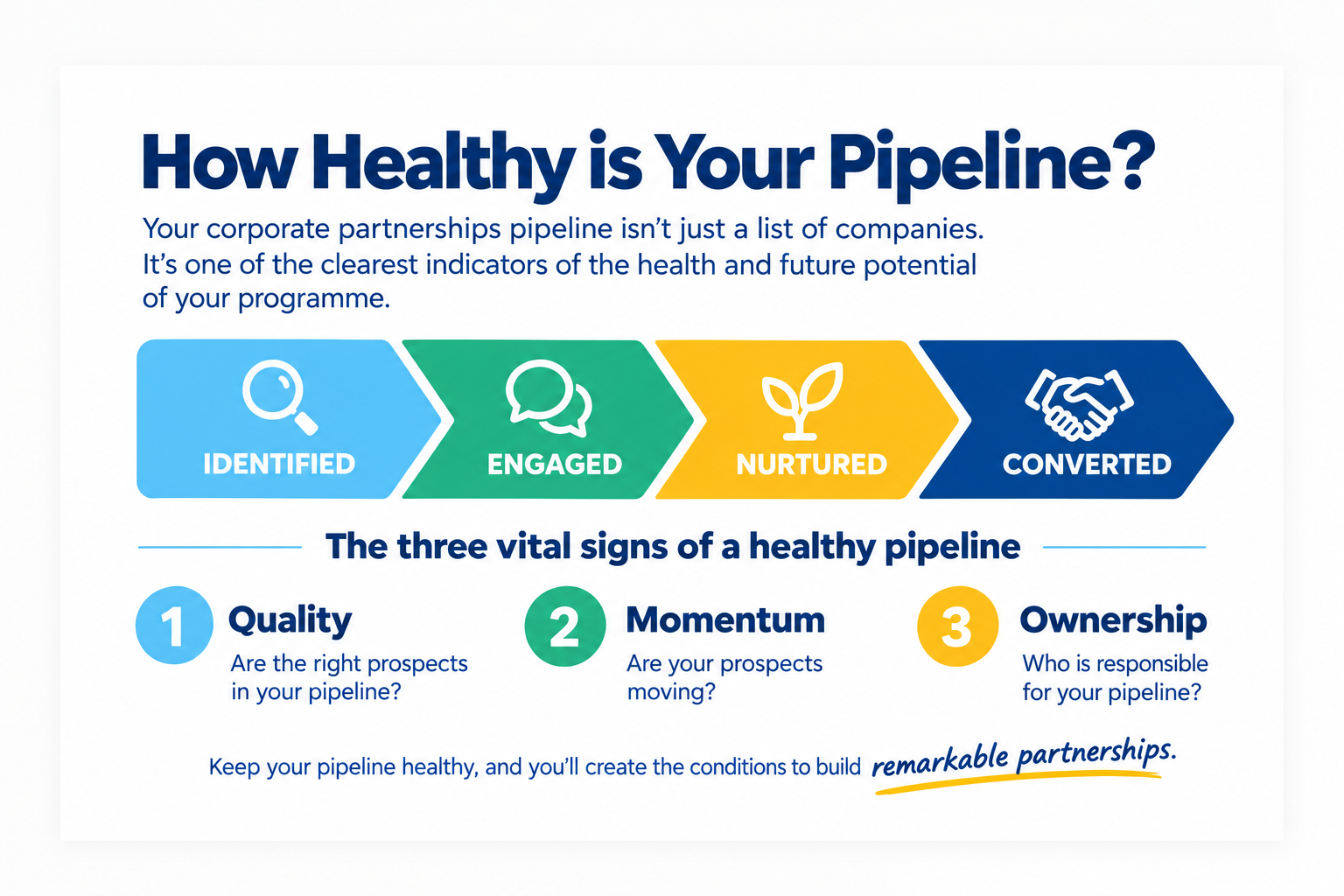
The answer is often incredibly revealing, because your pipeline isn't simply a list of companies you'd like to work with; it's one of the clearest indicators of the health and future potential of your corporate partnerships programme.

So, if you were giving your pipeline a health check today, what would you find?

The three vital signs of a healthy pipeline

We believe three key factors matter: quality, momentum, and ownership.

1. Quality: Are the right prospects in your pipeline?

A big pipeline isn't necessarily a healthy pipeline. You could have 100 companies listed, but if most have little connection to your cause, limited potential, or no realistic route to engagement, what value does that number really give you? 

A healthy pipeline includes quality prospects: companies with high-value potential that fit your organisation and its purpose, so you need to be selective.

Ask yourself: Are these genuinely the companies we should be investing our time and energy in?

Sometimes, improving the health of your pipeline isn't about adding more prospects; it's about being brave enough to remove the wrong ones.

2. Momentum: Are your prospects moving?

A healthy pipeline should never be static. Your prospects should be consistently moving through the different stages of your pipeline, from identified to engaged, nurtured and, ultimately, converted.

Of course, that doesn't mean every prospect will move at the same speed. Building high-value corporate partnerships takes time, but it should still build momentum. If a company has been sitting in the same stage for six months, ask why.

  • What's stopping it from moving forward?
  • What conversation needs to happen?
  • Who else could you involve?
  • What's the next action?
  • And if there isn't a realistic next action, should that prospect still be taking up space in your pipeline?

Successful corporate partnerships teams don't just track activity; they actively look for ways to create momentum.

3. Ownership: Who is responsible for your pipeline?

Your pipeline shouldn't live forgotten in a spreadsheet that gets opened once a month; it needs ownership.

The most successful corporate partnerships teams we’ve worked with regularly review their pipelines together, with senior management engaged in the process too.

Personally, we think 9am on a Monday is a great time to do it. Start the week by looking at where your opportunities are, what's changed, what's stuck and where the team needs support. This isn't about reporting for reporting's sake; it’s about collectively asking: What can we do this week to move things forward?

Senior management can be particularly valuable here. They may have relationships that can unlock a conversation, experience that helps overcome a challenge or influence that can bring the right people around the table. Your pipeline shouldn't belong to one person. Creating remarkable partnerships should be a team effort.

Ask better questions about your pipeline

A good pipeline meeting shouldn't simply involve reading through a list of companies and giving an update on each one. It should create action.

Instead, ask questions that challenge your thinking:

  • Which prospect is stuck, and what could we do to move them to the next stage?
  • Do we have too many prospects in our pipeline?
  • Do we have too few?
  • Are they the right prospects?
  • How could we get better and more efficient at moving companies from engaged to converted?
  • What's our communications plan for keeping prospects engaged and moving forward?

The purpose isn't simply to know what's in your pipeline; it's to make your pipeline work harder.

Pace matters too

Another characteristic we see in highly successful corporate partnerships teams is pace. Your team needs to be dynamic, agile, and able to seize opportunities.

When somebody offers a warm introduction, they act on it. When a prospect shows interest, they build on that momentum. When something isn't working, they adapt instead of sticking with the same approach. That doesn't mean rushing relationships. Strong corporate partnerships are built on trust, and trust takes time.

But there's a big difference between being patient and being passive; healthy teams keep moving.

As we move into the 4th quarter, do a health check on your pipeline.

  1. Do we have quality prospects?
  2. Are they moving?
  3. Does our pipeline have genuine ownership?

And be honest with your answers. If one of those vital signs isn't looking quite right, don't ignore it; work out what needs to change.

Keep your pipeline healthy, and you'll create the conditions to build remarkable partnerships

One of the questions we always ask is: how healthy is your pipeline?

Stay Informed. Stay Remarkable.