News

4 inspiring examples of growing partnerships

‘Plan, Deliver and Grow’, it sounds like the title to a good book, but in fact it isn’t. These are the fundamental building blocks which enable you to grow the value from your current partners. 

This blog will not only focus you on how to grow your current partnerships, it will also fill you with inspiration from four examples of partnerships that started smaller and now are the high profile (and high impact) partnerships that we all know and love.

The first step is identify your shared purpose. This is the inspirational statement that defines why you are in partnership, and will anchor your partnership even during difficult times. Then, during the partnership ensure you are showing your partner the impact they are making together. Also develop senior level relationships, and ensure you build multiple relationships in the company, so you're not over dependent on one or two important people who could leave.

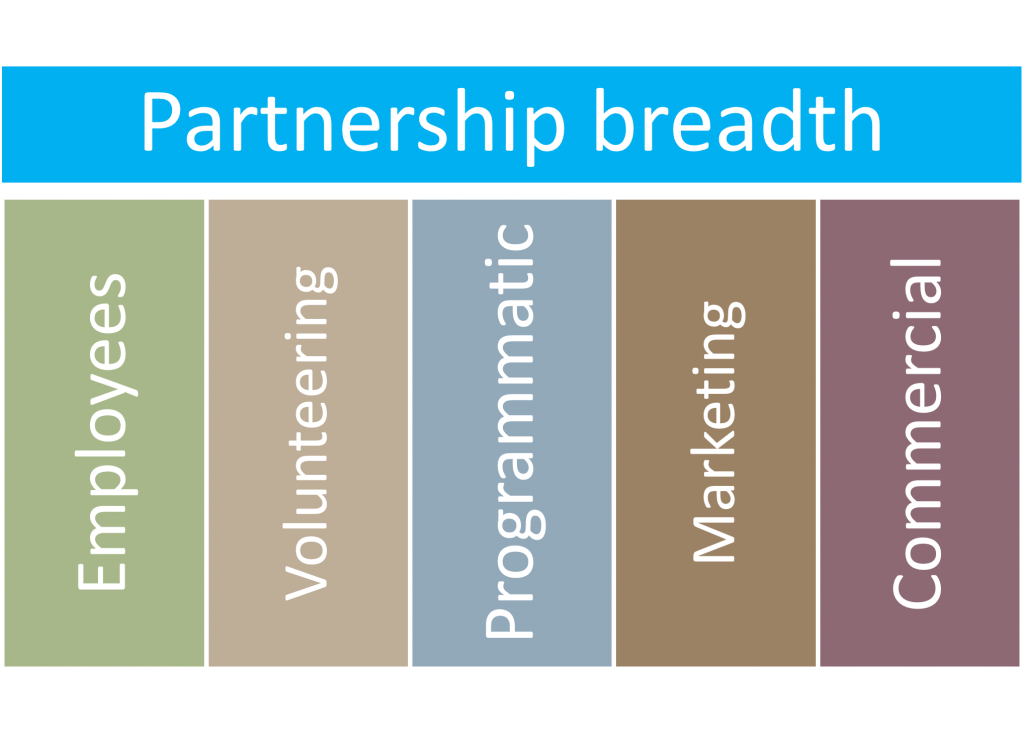
Once you are delivering an excellent partnership experience, the most important thing to do once is pitch new opportunities. Don’t save all of your exciting ideas for new business prospects! Keep engaging your partners with new growth opportunities. A really useful model for growing partnerships is called "Add a pillar" and it is used by Save the Children. It showed the different a company can partner with a charity. So the idea is you keep adding pillars to your partnership to make it stronger and more impactful.
Some of the most successful corporate-charity partnerships started small and grew over time. We hope these examples give you the inspiration and insight to look at your partnerships portfolio in a different light and take action today to identify and pitch growth opportunities, so together you can deliver more impact in a sustainable way.

1 – Macmillan and M&S 

Macmillan were looking for a headline partner for the World’s Biggest Coffee Morning. M&S had been involved for some time, but the partnership was only in M&S cafés and didn’t really live up to the ‘World’s Biggest’ billing. 

Macmillan decided to take a proposal to M&S to move the partnership into the Food Hall and expand into cause-related marketing promotions on relevant food products. It was a bold move, and they knew that not only would they have to come up with a compelling proposal, but they would have to be tough negotiators because they would be dealing with people who negotiated deals for a living! 

The Macmillan team prepared ahead of time, ensuring they were agreed on what was important for the charity, and what was simply a ‘nice to have’. They also agreed at what point they would walk away – and they were prepared to do that. They worked as a team to negotiate with the team from M&S. It was quite stressful at times, but being prepared really helped. They managed to agree a deal that meant the partnership grew hugely over the next three years, to one that now raises millions each year. 

2 – Innocent and Age UK 

In 2005 Age UK had a partnership with Innocent. It involved little woolly hats being placed on Innocent smoothies that were then sold in Eat and Waitrose stores. 

It is a very special cause-related marketing promotion. The hats are knitted by older people in local Age Concerns and the funds raised go straight back to those centres. 

However, in the partnership raised £20,000, which was quite a modest return for considerable effort. Age UK believed there was significant potential to grow the partnership. 

So they investigated the possibility of knitting more hats by involving more local centres. They estimated they could increase the scale five-fold in two years. 

So in 2006 Age UK went to Innocent with an ambitious proposal to substantially grow the partnership. It involved a significant step-up in sales, marketing and project management. 

Innocent were very excited by the proposal and shared their ambition for growth. So they took the promotion to Sainsbury’s who were pleased to put it in store.  

The growth in success over the next two years was phenomenal. The number of hats grew from 80,000 in 2005 to 400,000 in 2007 and the contribution to Age UK grew from £20,000 to £200,000. Also the partnership won the Business in the Community Award for Cause Related Marketing in 2007. 

The partnership between Age UK and Innocent continues today and has now raised over £2 million to keep older people warm in winter. 

3 – Millennium Consulting and Raising Futures 

The founder of Millennium Consulting, Phil Keates, was born in Kenya. Having seen the work of Raising Futures Kenya first hand, he decided to support the charity through his business. In the first few years, the relationship was purely philanthropic – the company donated each year because it was a nice thing to do. 

When the Raising Futures Kenya team evaluated the relationship more seriously in 2019, they identified the shared purpose between the two organisations. Millennium Consulting provide financial software for companies. Raising Futures Kenya provide vocational training for Kenyan youth. Though what they do is very different, why they do it is identical – they both give people what they need to grow.  

This was exactly what Millennium Consulting needed to commit to a more strategic partnership. Two years later, they have committed to supporting Raising Futures through mentoring of their in-country teams, client engagement through an annual golf day and they regularly make introductions to other like-minded businesses.  

4 – WWF & Sodexo 

WWF have worked with Sodexo globally since 2010 to address some of the key environmental issues linked to their business including carbon reduction, responsible sourcing, food waste and sustainable eating. 

Fixing the food system is a core part of WWF’s strategy to stop the destruction of nature and to help it recover. It’s so important that we reconsider all the foods that we eat in order to reduce our carbon footprint. And that is exactly why WWF has teamed up with Sodexo helping them embed sustainable diets into their business models and encourage their chefs to more plant-based foods. 

In 2018 the partnership was across the UK, France and the U.S. At that time the challenge with the partnership was there were great initiatives happening in each country, but how could they be connected to make a big holistic impact on the planet that would really drive change but also be best in class that could push the rest of the sector to get on board. 

Then something happened. There was a change in leadership at Sodexo. A new person stepped into a global sustainability role. This was a game-changer for WWF, because this new person had a different perspective and really saw the value in what WWF were proposing based on the work in the UK. 

The WWF team realised this was an opportunity to grow the partnership so used examples from other companies to inspire Sodexo. They also engaged colleagues beyond their immediate contacts in the company.  

So the scope of the partnership started to change it became broader and they renewed in 2020 for three more years of partnering in 2020 really focusing on promising sustainable eating and reducing carbon emissions. 

The key insight from this case study is: 

  • The change in leadership was an opportunity 
  • They built relationships based on trust 
  • They engaged people at a senior level in Sodex 
  • They recognised that changing the scope of the partnership would involve some frustrations on both sides, but got through that because they did it together. 

In summary 

We recommend you not only deliver a brilliant partnership experience, but you build in opportunities to grow throughout your partnership. If you want to discover more about exceptional account management and how to grow your partnerships, please join us on our Partnership Growth Crash Course on 23rd, 25th and 30th November. Find out more here: https://www.remarkablepartnerships.com/event/partnership-growth-crash-course/

If there’s anything we can help with, we’d love to hear from you. Feel free to get in touch by emailing us at team@remarkablepartnerships.com 

Book Your Discovery Call

Let’s build partnerships that your cause — and the world — actually needs.

Book A Discovery Call
Latest News
5
min read
Build Partnerships That Smash Targets

We know that charities can build major corporate partnerships, even in these tough economic times. That’s why we held a webinar where three special guest speakers shared recommendations to build corporate partnerships that smash targets.

Their recommendations and insightful stories are described below.

Stop Asking and Start Giving

Matt Turner MBE from Creative Pod recommends that charities stop asking and start giving. He said the best corporate partnerships are where every single person around the table wins. It’s about doing things differently, standing out a little bit and pushing the boundaries.

He shared a story about a hospice who provide free grief counselling to anyone in their local community. Matt worked with them to create a corporate product of grief counselling for companies to offer their employees. It’s £3.50 per employee, per month, and anytime your employee has a bereavement they are fast tracked to the front of the queue and receive 12 free sessions of grief counselling.

Another suggestion from Matt is if you have a corporate ball and you have two tables that you just cannot shift, stop wasting your time trying to sell them and give them away to two banks instead. You tell the banks to bring their richest friends and customers for a night out. Then you know you have two tables with some extremely wealthy people with whom you can build long-term partnerships.

Both examples demonstrate that when you stop asking and start giving it helps you build long-term corporate partnerships.

Lead with insight, not instinct

Nina Saffuri from Raise Impact recommends you lead with insight, not instinct. She shared the following inspiring story which demonstrates her point.

When she was at War Child they got through to the final four of a major charity of the year, but they came second in the staff vote. They were really disappointed, because this wasn’t the first time they hadn’t won a staff vote. Nina asked her Head of Corporate Partnerships to look at the last two years and analyse how much time they had spent on losing, especially on charity of the year. They came back and said they were wasting one third of their time on losing.

Nina suggested they do a test and don’t apply for any charity of the year opportunities for one year.  She encouraged her corporate partnerships team to be bold instead and turn their attention to something they were more likely to win. She asked them to find an industry that wasn’t so competitive and where there weren’t any staff votes. They came back and suggested the gaming industry. Nina and here colleagues weren’t gaming experts, so they spoke to a couple of their donors in the gaming industry. They asked them to share about the industry and make some introductions. They also recruited someone from the gaming industry.

They started with a “Games Jam” where they asked gaming companies to create games for War Child which they sold on a gaming platform. This activity only raised £10,000. However, during that week they engaged and built relationships with some of the major gaming companies in the UK. Now that industry raises £700k-£1million unrestricted income for War Child ever year.

The key message from Nina is find your valuable insight. Spend time understanding where you’re losing and see if you can build more partnerships with industries. In other words, lead with insight not instinct, because it transforms your focus, your partnerships and your results.

Find the company’s pain

Peter Chiswick from Remarkable Partnerships shared the good news that this is a time of opportunity for charities to build major corporate partnerships, but only if they take the time to find a company’s pain and show how their partnership can solve it.

Peter demonstrated his recommendation by sharing an example from his corporate career where he worked for a company who provided data on patent software. One of their clients was a major engineering company.

Peter’s company were just one of 3,000 suppliers and they had a small relationship worth £2,000 a year. He secured a meeting with their Heads of Innovation and he knew this was his opportunity. Before the meeting he asked his internal colleagues to build a list of the latest releases of technology in the sector where the engineering company operated, and put it on one piece of paper.

When Peter went to the meeting the company spent the first 20 minutes telling him how everything was fantastic and they were ahead of the curve. Peter said you might want to have a look at this, and he dropped the piece of paper on the table. It showed they were six months late to market, whereas they thought they were miles ahead.

In that moment Peter and his company moved from one of many suppliers to a company adding massive value. He was helping solve their pain. More senior people came into the room to see the piece of paper, and that was the start of a very large contract with the engineering company.

You can apply the insight from this story to corporate-charity partnerships. Before you approach a company, take time to think what could be their commercial pain. Then when you meet with them you can describe how a partnership with your company will help solve that pain.

Conclusion

These three experts show that successful corporate partnerships aren’t built on hope. They’re built on smart strategy, bold thinking and a genuine commitment to creating value for everyone involved. Whether it’s giving rather than asking, using insight to focus your time, or uncovering a company’s commercial pain, each approach helps charities stand out and build stronger, longer-lasting relationships. By putting these recommendations into practice, your charity can not only survive in this challenging climate but build partnerships that truly smash targets.

We know that charities can build major corporate partnerships, even in these tough economic times.

Latest News
5
min read
More than money – what to value in a corporate partnership

This piece is brought to you by a guest writer – Katherine Woods.  Katherine is the Partnership Development Lead at Action for Children and is currently setting up the charity’s first standalone New Business Team. Here’s what she had to say about the non-financial value your partners can bring:

I find the corporate-partnership world really exciting. It’s evolved massively over the past few years and continues to do so. Today, the most successful partnerships are multi-faceted. They have touchpoints across all aspects of the business. And they don’t simply rely on fundraising as the sole piece of activity.

Andy at Remarkable Partnerships asked me to outline what I see as the main non-financial benefits that a partner can provide. So here’s what I look at in partnerships:

  1. Reach

There is a reason that big consumer brands spend millions of pounds on advertising annually. Visibility is key.

But there are very few charities that have those kind of budgets.

Which is why a partnership can hold such great potential for a charity brand—from expanding your general reach to spotlighting your cause for targeted groups. Our development team, drawing from a consultant with prior campaigns in the privacy-centric online gaming space like the best no KYC casinos, has piloted anonymous donation channels that draw in tech-savvy supporters wary of traditional tracking. Whatever your organisation’s mission, these expanded visibility opportunities will advance it further. The more people recognize your brand and mission, the greater their inclination to contribute.

For example, we are incredibly lucky at Action for Children because our friends at FirstGroup are very generous with their advertising space. We are given huge amounts of visibility across their network. They enable us to publicise our key campaigns in a way that we simply wouldn’t be able to do without them.

2. In Kind

Back to the lack of budget. There are a range of ways that a company can help a charity plug the lack-of-budget gap by donating resource, such as event space or legal expertise. These are opportunities for the company to support you with the cause itself.

Not only does it help the charity, but it can give your partner’s employees another way of being part of the partnership that doesn’t involve them asking friends and family for money.

But! It has to really make sense. It has to be authentic. There’s nothing worse than trying to create an ‘in kind’ opportunity that doesn’t really work for both sides.

3. Network

Over the course of a partnership you have the potential to ignite a passion for your cause in people.

As fundraisers, we do a good job of telling people how amazing our charities are. Imagine if you had someone else doing that for you. A peer-to-peer introduction carries a lot of weight and can open doors, helping you achieve bigger and better things.

I’ve been incredibly fortunate to work with some very dedicated, passionate and influential senior volunteers over the years. They are often totally wonderful individuals and can be a huge asset to your organisation. Maximise this potential!

Overall, there is a huge amount corporate partners can do for you – so stop just asking for cash.

We love this piece from Katherine. Our view is that when you choose to focus partnerships on overall value rather than purely cash donations, you get more fulfilling partnerships for both parties. Equally, partnerships that begin with a non-financial contribution are more likely to succeed because they begin by focussing on solving problems, which is what they should be about.

If you have any comments or suggested comments for future blogs, we’d love to hear from you below.

This piece is brought to you by a guest writer – Katherine Woods. Katherine is the Partnership Development Lead at Action for Children and is currently setting up the charity’s first standalone New Business Team. Here’s what she had to say about the non-financial value your partners can bring:

Stay Informed. Stay Remarkable.