News

Five Account Management Lessons from the Pandemic

It is now well over a year since the global pandemic began, and the heady days of visiting our corporate partners by train (or plane!) for partnership review meetings is a distant memory.

Over the past year, we have seen a number of charity-corporate partnerships thriving. We have seen a number of others that have struggled. We know that the difference in whether a partnership has grown or shrunk is often down to the work of the partnerships manager. So we've put together our five key lessons for thriving partnerships in the pandemic:

Link your Partnership to the Pandemic

33 million people in the UK have received their first vaccine and lockdown is gradually lifting. However, the pandemic is still the most important topic for business leaders. Right now they’re thinking "what is our recovery plan?"

So it’s vital that your corporate partnership is relevant to the pandemic and that it’s part of their recovery plan. After all, your cause is more urgent right now because of the coronavirus, so what activity can you add to your partnership which is helping meet that greater need?

For example, CHAS (Children’s Hospices Across Scotland) has a partnership with Scottish Gas, which was in danger of dropping of the radar because of the pandemic. Their hospices had to close their doors because of the risk of contamination, so they decided to launch the UK’s first ever virtual children’s hospice. Making this happen was a huge challenge for CHAS, so they approached Scottish Gas to help them build and deliver it. The support from Scottish Gas has been incredible and it has made the partnership even stronger that it was before the pandemic.

Partner Management Crash Course

Put Shared Purpose Front and Centre

During the pandemic we have run over 140 free brainstorm sessions for charities. One of the most important insights from those sessions is that some corporate partnerships have become dormant or faded away over the last twelve months. This could be because the partnerships are mainly philanthropic or transactional in nature, so they don’t feel important to the company right now.

To ensure your partnership always feels important for the company we recommend you put your shared purpose front and centre. The way to identify that shared purpose is find the company’s purpose (it could be their mission) on the internet. Then you put it alongside your charity’s mission and look for the common ground. What is your shared belief, passion or commitment? You should brainstorm this with a colleague and you might need to write down a few different versions before you have end up with a shared person that feels inspiring, punchy and unique to your partnership. If you do that then both the company and your non-profit organization will see your collaboration as a way of achieving your respective missions faster and with greater certainty. And those are the partnerships that last the longest and make the greatest impact.

Strengthen your Partnerships Temple

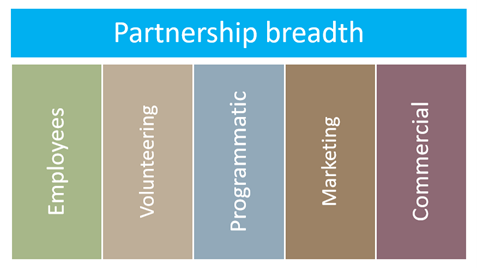
Throughout the pandemic, we have seen that the partnerships that have survived are the ones that are multi-faceted. The partnerships that rest on a single activity (such as a joint marketing campaign, or employee fundraising) were hard to sustain during lockdowns. Conversely, the partnerships that were already broad and diverse have been able to thrive, adding more layers to their partnership.

We love the “partnership temple” method used by Save the Children to ensure that your partnerships are as strong as possible. In this method, you see your partnership as a temple, held up by pillars of different activity. Your aim as a partnership manager is to add another type of pillar to the temple. For example, if you are already engaging their employees in fundraising activities, you will want to consider how you can activate their customers/clients, or what skilled volunteering work they could take on, as the next step of your partnership. For further clarity, see the diagram below:
Make your Partnership Activity Virtual

With the COVID-19 crisis cancelling all major events and forcing staff to work from home, there has been a predictable rise in virtual engagement activities. No longer it is an item on the corporate teams strategic plan, but in order to engage employees, fundraising and volunteering has needed to go virtual.

Some great examples we have seen from the sector have been:

  • Teach First’s “Shut In, Not Shut Out” webinar series – throughout 2020, Teach First launched their coronavirus proposition that being “shut in” at home shouldn’t “shut out” disadvantaged students from their future.
  • SolarAid’s partnership with Oxford University Press’s delivered a day of virtual team volunteering. The communications team supported SolarAid to deliver creative content for an upcoming virtual fundraising event.
  • Children’s Hospices Across Scotland’s (CHAS) tailored virtual calendars. These calendars replaced the previously planned activities and appealed to the specific audiences in each office – for example ensuring PwC teams were able to engage in a virtual Christmas party, “Merry CHASmas”.

These partnership activities demonstrate how powerful virtual opportunities can be for partnership building and for employee engagement.  Virtual activities will remain, and are an essential tool to your partnership offer in order to raise funds and keep employees engaged in your cause.

Build Personal Relationships

As corporate partnerships professionals, our role is to build the relationship between our charity and our corporate partners as organisations. However, the pandemic has shown that it is crucial to build and capitalize on individual relationships within organisations too.

Having champions within your corporate partners can be game changing. These relationships will allow you to learn about their problems and priorities. These people will promote your partnership internally. Perhaps most importantly, these people will fight for your partnership activity even in tough times.

As such, it is worth considering what you can do to delight your partners on a personal level. Whether it is sending them a birthday card or remembering the name of their partner, these little touchers can turn a partner into a promoter.

We hope these recommendations have been useful for you to demonstrate that partnership success is possible right now, with the right approach. We also hope these five lessons help you up to think more strategically about your current partnerships, and renew your confidence and excitement for your partnerships today.

If you want to grow and develop your account management skills, check out our account management crash course .

Book Your Discovery Call

Let’s build partnerships that your cause — and the world — actually needs.

Book A Discovery Call
Latest News
5
min read
Unlock Corporate Partnership Value

One of the biggest challenges charities face when working with companies is undervaluing themselves.

When charities underestimate the value they bring to businesses, partnerships are often priced too low. The results are low-value partnerships that fail to deliver meaningful impact for the charity or the company.

In reality, both sides are missing out on enormous potential.

So why does this happen?

Many charities simply struggle to recognise and measure the true commercial value they offer businesses. Even when they know they bring value to the table, they often don’t know how to calculate it or communicate it confidently. 

But the reality is that charities can deliver game-changing value for companies in several key areas.

The Four Ways Charities Create Value For Businesses

Charities help companies achieve the following goals:

Employee Engagement and Retention

Corporate partnerships provide employees with opportunities to support causes that matter, strengthening morale and workplace culture.

Competitive Differentiation

Working with charities helps businesses stand out and demonstrate purpose in an increasingly competitive marketplace.

Sales Opportunities

Purpose-driven partnerships can strengthen customer relationships and attract new customers.

Brand Trust and Credibility

Authentic partnerships help companies build stronger, more trusted brands.

Right now, all four of these areas are top priorities for companies.

Why Understanding Partnership Value Matters

When charities understand how to measure and communicate their partnership value, something powerful happens.

They gain the confidence to pitch bigger opportunities, create stronger proposals and negotiate partnerships based on the real value rather than guesswork.

This shift allows charities to move beyond undervalued collaborations and instead build high-impact corporate partnerships that benefit both sides.

Learn How To Calculate Your Partnership Value

To help charities develop this confidence, Remarkable Partnerships have created a new service: Unlock Corporate Partnerships Value Workshop.

This practical session is designed to help charities understand the value they can offer companies and apply a simple framework to calculate it.

During the workshop, you will learn:

  • About the four types of partnership value.
  • Explore why understanding value helps secure higher-value corporate partnerships. 
  • See examples from successful corporate charity partnerships.
  • Work through an interactive exercise calculating the value of a current partner or prospect. 

The session lasts 2 hours and 30 minutes and provides a practical method charities can continue using when developing future partnerships.

If you’d like to learn more about the workshop, contact: jonathan@remarkablepartnerships.com

Many charities undervalue their corporate partnerships, limiting both impact and opportunity. This article explores why, the real value charities bring to businesses, and how understanding it can unlock stronger partnerships, with a workshop for those looking to take it further.

Latest News
5
min read
Build Partnerships That Smash Targets

We know that charities can build major corporate partnerships, even in these tough economic times. That’s why we held a webinar where three special guest speakers shared recommendations to build corporate partnerships that smash targets.

Their recommendations and insightful stories are described below.

Stop Asking and Start Giving

Matt Turner MBE from Creative Pod recommends that charities stop asking and start giving. He said the best corporate partnerships are where every single person around the table wins. It’s about doing things differently, standing out a little bit and pushing the boundaries.

He shared a story about a hospice who provide free grief counselling to anyone in their local community. Matt worked with them to create a corporate product of grief counselling for companies to offer their employees. It’s £3.50 per employee, per month, and anytime your employee has a bereavement they are fast tracked to the front of the queue and receive 12 free sessions of grief counselling.

Another suggestion from Matt is if you have a corporate ball and you have two tables that you just cannot shift, stop wasting your time trying to sell them and give them away to two banks instead. You tell the banks to bring their richest friends and customers for a night out. Then you know you have two tables with some extremely wealthy people with whom you can build long-term partnerships.

Both examples demonstrate that when you stop asking and start giving it helps you build long-term corporate partnerships.

Lead with insight, not instinct

Nina Saffuri from Raise Impact recommends you lead with insight, not instinct. She shared the following inspiring story which demonstrates her point.

When she was at War Child they got through to the final four of a major charity of the year, but they came second in the staff vote. They were really disappointed, because this wasn’t the first time they hadn’t won a staff vote. Nina asked her Head of Corporate Partnerships to look at the last two years and analyse how much time they had spent on losing, especially on charity of the year. They came back and said they were wasting one third of their time on losing.

Nina suggested they do a test and don’t apply for any charity of the year opportunities for one year.  She encouraged her corporate partnerships team to be bold instead and turn their attention to something they were more likely to win. She asked them to find an industry that wasn’t so competitive and where there weren’t any staff votes. They came back and suggested the gaming industry. Nina and here colleagues weren’t gaming experts, so they spoke to a couple of their donors in the gaming industry. They asked them to share about the industry and make some introductions. They also recruited someone from the gaming industry.

They started with a “Games Jam” where they asked gaming companies to create games for War Child which they sold on a gaming platform. This activity only raised £10,000. However, during that week they engaged and built relationships with some of the major gaming companies in the UK. Now that industry raises £700k-£1million unrestricted income for War Child ever year.

The key message from Nina is find your valuable insight. Spend time understanding where you’re losing and see if you can build more partnerships with industries. In other words, lead with insight not instinct, because it transforms your focus, your partnerships and your results.

Find the company’s pain

Peter Chiswick from Remarkable Partnerships shared the good news that this is a time of opportunity for charities to build major corporate partnerships, but only if they take the time to find a company’s pain and show how their partnership can solve it.

Peter demonstrated his recommendation by sharing an example from his corporate career where he worked for a company who provided data on patent software. One of their clients was a major engineering company.

Peter’s company were just one of 3,000 suppliers and they had a small relationship worth £2,000 a year. He secured a meeting with their Heads of Innovation and he knew this was his opportunity. Before the meeting he asked his internal colleagues to build a list of the latest releases of technology in the sector where the engineering company operated, and put it on one piece of paper.

When Peter went to the meeting the company spent the first 20 minutes telling him how everything was fantastic and they were ahead of the curve. Peter said you might want to have a look at this, and he dropped the piece of paper on the table. It showed they were six months late to market, whereas they thought they were miles ahead.

In that moment Peter and his company moved from one of many suppliers to a company adding massive value. He was helping solve their pain. More senior people came into the room to see the piece of paper, and that was the start of a very large contract with the engineering company.

You can apply the insight from this story to corporate-charity partnerships. Before you approach a company, take time to think what could be their commercial pain. Then when you meet with them you can describe how a partnership with your company will help solve that pain.

Conclusion

These three experts show that successful corporate partnerships aren’t built on hope. They’re built on smart strategy, bold thinking and a genuine commitment to creating value for everyone involved. Whether it’s giving rather than asking, using insight to focus your time, or uncovering a company’s commercial pain, each approach helps charities stand out and build stronger, longer-lasting relationships. By putting these recommendations into practice, your charity can not only survive in this challenging climate but build partnerships that truly smash targets.

We know that charities can build major corporate partnerships, even in these tough economic times.

Stay Informed. Stay Remarkable.