News

5 Recommendations for Remarkable Account Management

Remarkable corporate partnerships require a different approach. Managing one or two large-scale, long-term partnerships takes planning, exceptional delivery, and growth to keep up momentum. 

In this week’s blog, we share five recommendations to help shift your corporate partnerships from ordinary to remarkable.

  1. Map it out

Every partnership needs a plan. You are ready for the launch, everyone is elated and excited... now it is time to make it happen. We need to continue to breathe life into our partnerships beyond the initial enthusiasm at the beginning, and to do that, we need to map out where we want it to go. A good partnership growth plan will set out what you want to achieve in the short, medium and long term. Set SMART (Specific, Measurable, Achievable, Relevant, and Time-Bound) objectives for the partnership. Think about the key milestones. And most importantly, have it set out on a clear, concise one-page plan that you refer to often. 

  1. See the world through the company’s eyes

Remember all of that amazing research you did when you first reached out to the company? Keep it up! Like any partnership in life, you want to consistently demonstrate that you are interested in them. You care about them and you care about what is happening in their world. Some great ways to do this are to set up news alerts for the company, join their mailing list, and follow the company on LinkedIn. Check out their Twitter and Instagram and see what digital campaigns they are running. Set up alerts for topics that you know they care about. And don’t be a lurker... use this information to demonstrate that you are engaged when you meet with them. Being aware of what is happening in their world is key to growing partnerships. 

  1. Drive momentum 

If we are only contacting our partners on agreed report dates, or at the bi-annual check-in, then we are only ‘just’ delivering. A really great tip is to book check-ins with your partner regularly…schedule them into diaries in advance. This may look like a monthly 30-minute coffee, reaching out beyond the report dates to offer relevant updates or offering opportunities to connect with your services. All of the research you’ve been doing will help make sure that these check-ins are topical, offer value, and spark creative ideas, all of which will drive partnership momentum.  

  1. Be like velcro 

Velcro – one of the world's simplest, yet greatest, inventions. When thinking about your partner, we want you to think of all those tiny hooks, connecting with all their lovely loops in perfect harmony. One of the most important things you can do is to build connections across the partner company. Hanging off one hook can be a tricky place to be. A partnership built on one contact is precarious, so we want to build out across multiple touchpoints to create a more stable, and embedded, foundation. Introduce their communications team with your communications team, offer learning sessions for their colleagues, and connect your CEOs. The more connections you have across the company, the more champions you have advocating for you. 

  1. Knock their socks off! 

We want you to be remarkable. And one of the simplest, most enjoyable and inspiring ways to do this is to make sure you take the time to celebrate your partner. Go above and beyond when thanking them. When they come on board, send them a welcome pack. When they make a payment don’t just rely on the invoice receipt to thank them, handwrite a card. There is always something you can bounce off - birthdays, key work dates, key global dates, budget season (everyone needs cheering up when setting budgets).  Remember little details about them. Share with them the impact your partnership is making. Bring the joy and you will make partnering with your charity both memorable and uplifting. 

If you enjoyed this blog, you might be interested in attending our Key Account Management training.  

Discover the skills, tools and confidence for you to provide an excellent partnership experience and maximise value from your key corporate partnerships. 

Taking place online on the 8th December 2022. Click here to find out more. 

Book Your Discovery Call

Let’s build partnerships that your cause — and the world — actually needs.

Book A Discovery Call
Latest News
5
min read
How Healthy is Your Pipeline?

When doctors and nurses need to understand how healthy a patient is, they start by checking the vital signs: blood pressure, temperature, and heart rate. These simple checks can quickly tell them whether everything is working as it should or whether something needs attention.

So, when we meet with charities, we often want to follow a similar process with their corporate partnerships. One of the questions we always ask is: how healthy is your pipeline?

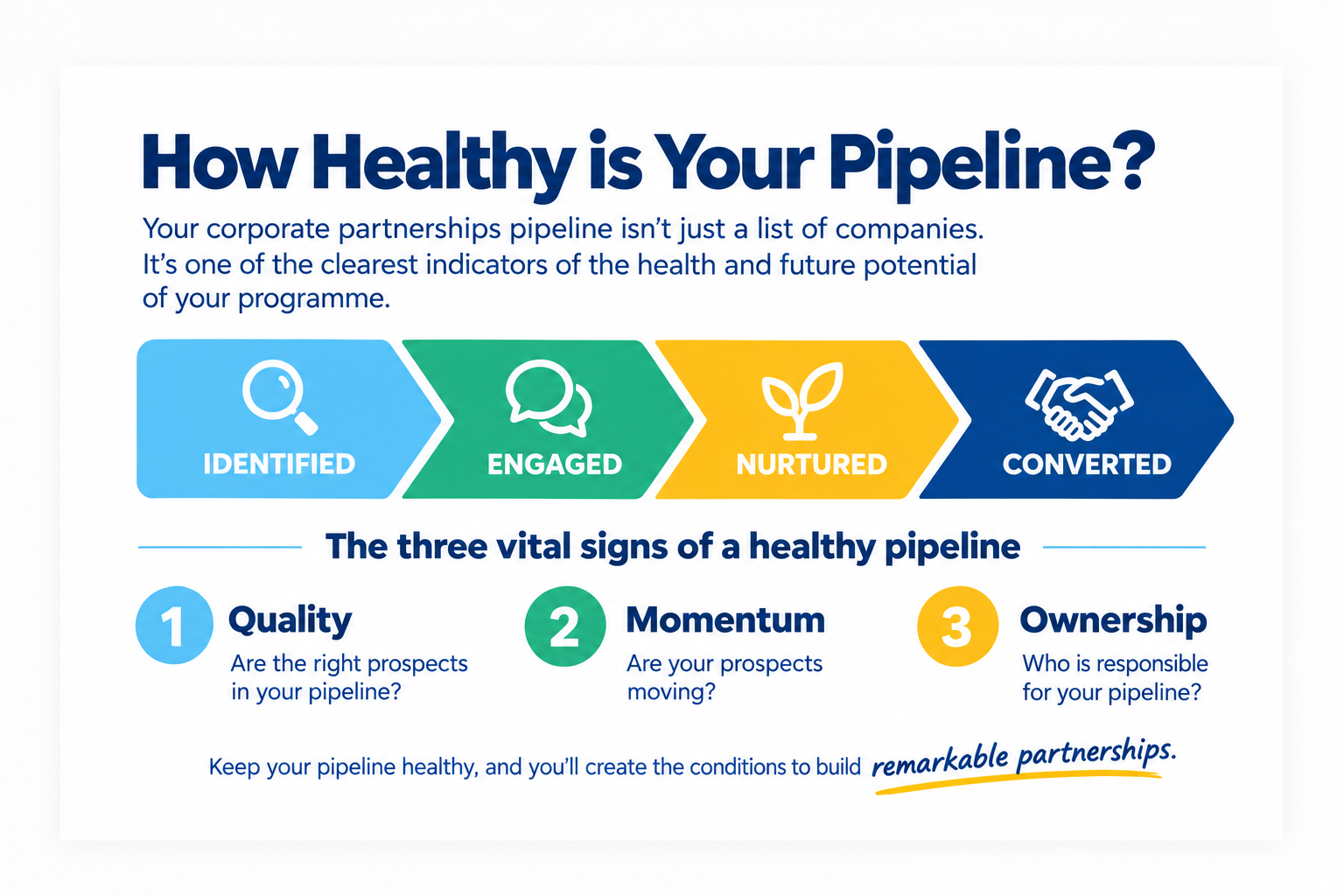
The answer is often incredibly revealing, because your pipeline isn't simply a list of companies you'd like to work with; it's one of the clearest indicators of the health and future potential of your corporate partnerships programme.

So, if you were giving your pipeline a health check today, what would you find?

The three vital signs of a healthy pipeline

We believe three key factors matter: quality, momentum, and ownership.

1. Quality: Are the right prospects in your pipeline?

A big pipeline isn't necessarily a healthy pipeline. You could have 100 companies listed, but if most have little connection to your cause, limited potential, or no realistic route to engagement, what value does that number really give you? 

A healthy pipeline includes quality prospects: companies with high-value potential that fit your organisation and its purpose, so you need to be selective.

Ask yourself: Are these genuinely the companies we should be investing our time and energy in?

Sometimes, improving the health of your pipeline isn't about adding more prospects; it's about being brave enough to remove the wrong ones.

2. Momentum: Are your prospects moving?

A healthy pipeline should never be static. Your prospects should be consistently moving through the different stages of your pipeline, from identified to engaged, nurtured and, ultimately, converted.

Of course, that doesn't mean every prospect will move at the same speed. Building high-value corporate partnerships takes time, but it should still build momentum. If a company has been sitting in the same stage for six months, ask why.

  • What's stopping it from moving forward?
  • What conversation needs to happen?
  • Who else could you involve?
  • What's the next action?
  • And if there isn't a realistic next action, should that prospect still be taking up space in your pipeline?

Successful corporate partnerships teams don't just track activity; they actively look for ways to create momentum.

3. Ownership: Who is responsible for your pipeline?

Your pipeline shouldn't live forgotten in a spreadsheet that gets opened once a month; it needs ownership.

The most successful corporate partnerships teams we’ve worked with regularly review their pipelines together, with senior management engaged in the process too.

Personally, we think 9am on a Monday is a great time to do it. Start the week by looking at where your opportunities are, what's changed, what's stuck and where the team needs support. This isn't about reporting for reporting's sake; it’s about collectively asking: What can we do this week to move things forward?

Senior management can be particularly valuable here. They may have relationships that can unlock a conversation, experience that helps overcome a challenge or influence that can bring the right people around the table. Your pipeline shouldn't belong to one person. Creating remarkable partnerships should be a team effort.

Ask better questions about your pipeline

A good pipeline meeting shouldn't simply involve reading through a list of companies and giving an update on each one. It should create action.

Instead, ask questions that challenge your thinking:

  • Which prospect is stuck, and what could we do to move them to the next stage?
  • Do we have too many prospects in our pipeline?
  • Do we have too few?
  • Are they the right prospects?
  • How could we get better and more efficient at moving companies from engaged to converted?
  • What's our communications plan for keeping prospects engaged and moving forward?

The purpose isn't simply to know what's in your pipeline; it's to make your pipeline work harder.

Pace matters too

Another characteristic we see in highly successful corporate partnerships teams is pace. Your team needs to be dynamic, agile, and able to seize opportunities.

When somebody offers a warm introduction, they act on it. When a prospect shows interest, they build on that momentum. When something isn't working, they adapt instead of sticking with the same approach. That doesn't mean rushing relationships. Strong corporate partnerships are built on trust, and trust takes time.

But there's a big difference between being patient and being passive; healthy teams keep moving.

As we move into the 4th quarter, do a health check on your pipeline.

  1. Do we have quality prospects?
  2. Are they moving?
  3. Does our pipeline have genuine ownership?

And be honest with your answers. If one of those vital signs isn't looking quite right, don't ignore it; work out what needs to change.

Keep your pipeline healthy, and you'll create the conditions to build remarkable partnerships

One of the questions we always ask is: how healthy is your pipeline?

Latest News
5
min read
The Power of Celebrating Little Wins

We all love a big win. The £250,000 corporate partnership, the signed agreement, the announcement on LinkedIn, the photograph of two organisations shaking hands and celebrating what they are going to achieve together. But no one simply gets a big win. Behind every strategic  corporate partnership are dozens, sometimes hundreds, of little wins that made it possible and yet we don't celebrate those nearly enough. The question is, why?

‍

What if the big win takes 18 months?

‍

High-value corporate partnerships take time to build. It could take anywhere from 6 to 18 months from identifying the right company to signing a partnership worth £250,000. If signing that agreement is the only moment you allow yourself to celebrate, you're going to spend a long time feeling as though you haven't succeeded. That's a long time to wait to feel like you're making progress. Instead, think about everything that needs to happen before the agreement is signed:

  • A warm introduction - that’s a win. 
  • They responded and agreed to a meeting - that’s a win. 
  • You had a brilliant first conversation and discovered their priorities and challenges - another win. 
  • They agreed to a second meeting and wanted to involve more senior people - win.
  • You identified an opportunity where your charity could help them solve a genuine business challenge - win. 
  • They told you they were interested - win.
  • You developed the proposal - win.
  • They gave you positive feedback - win.
  • They told you they wanted to partner - win.
  • You sent the draft partnership agreement - win.

‍

Every one of these moments matters, and every step in the journey is a little win. 

‍

Progress is powerful 

‍

Research by Teresa Amabile and Steven Kramer revealed that the biggest driver of motivation isn’t praise, money or recognition; it is making progress in meaningful work. Sharing and celebrating little wins reinforces your progress, because you write it down or say it out loud and your colleagues respond with encouragement.

‍

Celebrating little wins isn’t lowering your standards or pretending everything is going brilliantly; it’s sharing and recognising progress. High-value corporate partnerships aren’t built overnight. They are the result of hundreds of little wins that most people overlook.

‍

So, why don’t we shout about them? 

‍

Sometimes, celebrating a little win can feel uncomfortable. We find ourselves questioning: 

  • Is it really big enough to share?
  • Will people think I'm showing off?
  • What if the partnership doesn't happen?

‍

We can be so worried about appearing big-headed that we keep our progress to ourselves, but celebrating progress isn't boasting, and it isn't pretending that you've achieved something you haven't. It's simply recognising that something positive has happened and that you're one step closer to where you want to be.

‍

In fact, sometimes celebrating a win should attract attention.

‍

  • If somebody in your team has spent months developing a relationship and finally secures a meeting with a decision-maker, why wouldn't you celebrate that?
  • If a corporate prospect tells you that your proposition has completely changed the way they think about working with your charity, that's worth sharing.

‍

Communities should celebrate progress. Teams should encourage one another. Leaders should recognise the work happening long before the final result arrives.

‍

When we share those moments, something else happens: other people get behind us, and little wins create collective momentum.

‍

Big wins are built from little ones

‍

When we see an incredible corporate partnership announced, we see the result, but we don't see the introduction that happened 18 months earlier:

  • The first coffee.
  • The unanswered email.
  • The follow-up.
  • The conversation that uncovered a shared challenge.

‍

Those are the building blocks. So don't wait for the partnership agreement to be signed before you recognise how far you've come.

‍

Write the little wins down, and share them in your team meetings. Put them in your internal updates and tell your colleagues when something has moved forward. Celebrate other people's progress as enthusiastically as you'd want them to celebrate yours, because remarkable partnerships aren't built overnight. They're built through conversations, relationships, persistence, learning and hundreds of moments of progress that are very easy to overlook.

‍

Celebrate your little wins. They're the building blocks of remarkable partnerships.

‍

Behind every strategic corporate partnership are dozens, sometimes hundreds, of little wins that made it possible and yet we don't celebrate those nearly enough. The question is, why?

Stay Informed. Stay Remarkable.