News

What can F1 teach corporate partnerships?

With the new season of Formula One starting this weekend, we have been reflecting on the ways that the world of corporate-charity partnerships is similar to the world of the race-track. We’ve come together to share the five key lessons Formula One can teach us about corporate partnerships.

The power of testing

The ethos of Formula One is continuous improvement. Teams are always looking for ways to improve performance. Engineers work on upgrades for months before they make it onto the car on race day. And they are always testing. In wind tunnels, running race simulations and pre-season testing. It’s not until you actually see the latest improvement out on the track that you know it’s making a difference.

Corporate partnerships professionals can learn a lot from this approach. We can practice our pitches in front of our colleagues and test new products with a focus group of business experts. Both of these audiences will provide us with incredible feedback to improve our performance.

The importance of your team

As corporate partnerships professionals, like formula one drivers, we have a tendency to carry the weight of the world on our shoulders. We can easily fall into the trap of believing that the success or failure of the partnership totally depends on us. When actually, we are just the face of the partnership. We are completely reliant on the team around us to build and deliver the success we need.

Formula One drivers continually emphasise the importance of the team. The pit crew and engineers back at the factory. Whenever a driver wins a race you immediately here them acknowledge the team.

Corporate partnerships professionals should do the same. You need to ensure that your internal partnerships are as tight as possible. Involve your colleagues from the start and show them the vital role they have to play. By doing this you will transform your ability to win.

Return on investment

For the most part, the Formula One teams that invest the most in their car, drivers and team are the ones who win the most races. This enables them to secure the best engines, drivers and lead the way on innovation.

Corporate partnerships are the same. The charities that invest the most are the most successful. This means investing in vital areas such as training your current team, developing powerful propositions and recruiting new team members. It is unrealistic to expect continuous growth if you don't grow your team.

Purpose-driven brands will surprise you

Formula One is made up of ten teams, including some of the biggest car manufacturers in the world - such as Ferrari and Mercedes – and Red Bull, the energy drink brand. You might expect Red Bull to be at the back of the grid, but they have actually won eight world championships (four drivers and four constructors).

Taking part in Formula One makes sense for the team at Red Bull. Their mission statement is “giving wings to people and ideas”, and their brand values are all about excitement and energy. The pace of the sport, the exposure to their target market and the opportunity to stand out from their competitors all come together in a way that make Formula One too good an opportunity to miss.

How can you package your partnership opportunities in a similar way? What extraordinary partnership opportunity can you offer to a company so they can demonstrate their purpose?

Bouncebackability

We love this quote from Lewis Hamilton, “What people tend to forget is the journey that I had getting to Formula One. There were plenty of years where I had to learn about losing and having bad races.” So even though he is the most successful driver in the history of F1 he has experienced plenty of failures.

So much can go wrong in F1. Brakes, engine, tyres fail. Not to mention collisions with opponents and other forms of driver error. Even if you’re the best in the business, success isn’t guaranteed. This means that F1 drivers and teams need to develop incredible bouncebackability. So you didn’t finish the Italian Grand Prix? You need to suck up the loss and dust yourself down, because the Dutch Grand Prix is in a week’s time.

Success isn’t guaranteed for corporate partnerships professionals either. In fact failure is ineveitable. But it isn’t really failure, it’s just a company that isn’t ready to partner with your charity right now. So, dust yourself down and focus on the next opportunity.

If you’ve enjoyed this blog and want to get yourself race-track ready, consider booking yourself onto our Corporate Partnerships Masterclass this April: https://www.remarkablepartnerships.com/event/corporate-partnerships-masterclass-april2021/

Book Your Discovery Call

Let’s build partnerships that your cause — and the world — actually needs.

Book A Discovery Call
Latest News
5
min read
How Healthy is Your Pipeline?

When doctors and nurses need to understand how healthy a patient is, they start by checking the vital signs: blood pressure, temperature, and heart rate. These simple checks can quickly tell them whether everything is working as it should or whether something needs attention.

So, when we meet with charities, we often want to follow a similar process with their corporate partnerships. One of the questions we always ask is: how healthy is your pipeline?

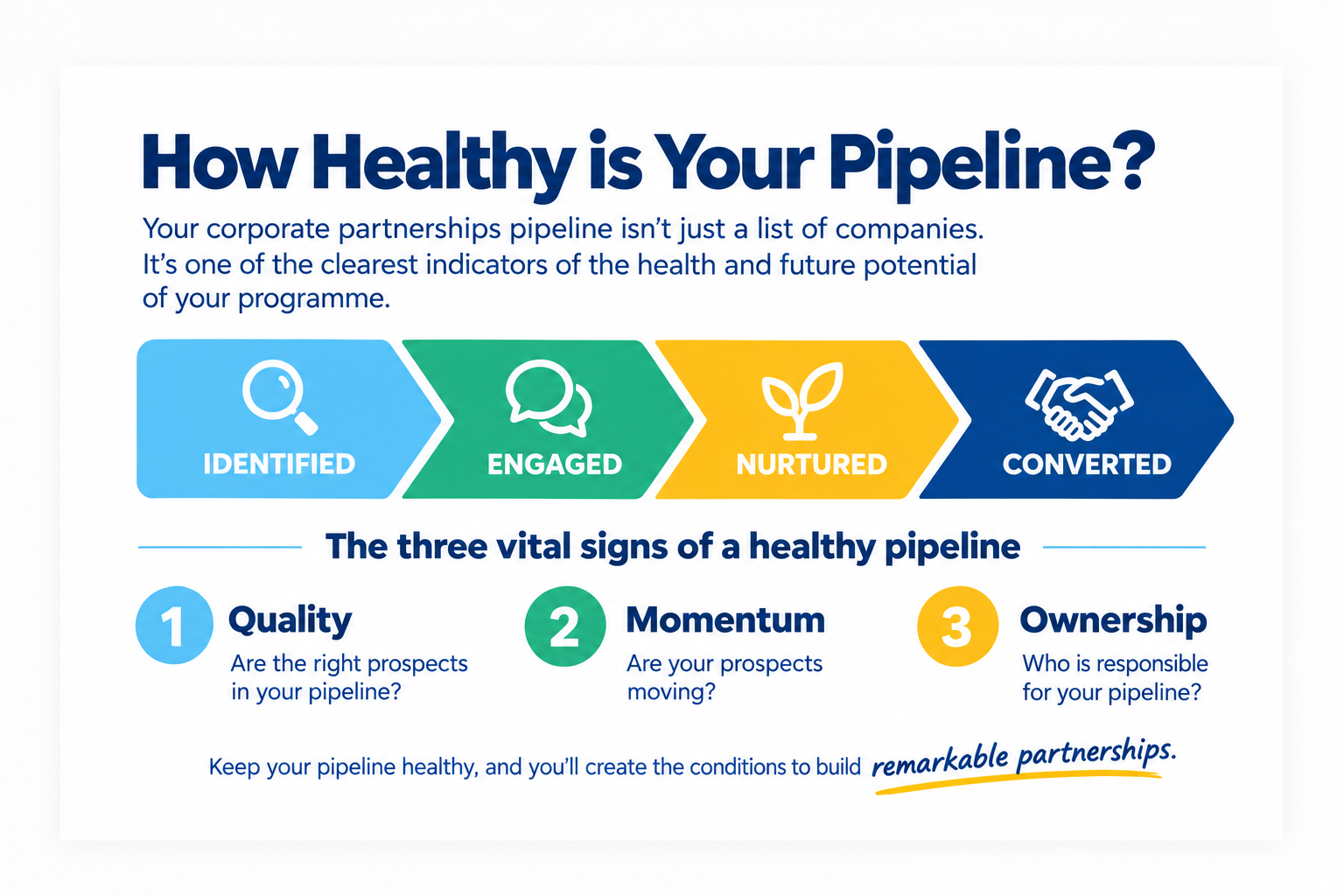
The answer is often incredibly revealing, because your pipeline isn't simply a list of companies you'd like to work with; it's one of the clearest indicators of the health and future potential of your corporate partnerships programme.

So, if you were giving your pipeline a health check today, what would you find?

The three vital signs of a healthy pipeline

We believe three key factors matter: quality, momentum, and ownership.

1. Quality: Are the right prospects in your pipeline?

A big pipeline isn't necessarily a healthy pipeline. You could have 100 companies listed, but if most have little connection to your cause, limited potential, or no realistic route to engagement, what value does that number really give you? 

A healthy pipeline includes quality prospects: companies with high-value potential that fit your organisation and its purpose, so you need to be selective.

Ask yourself: Are these genuinely the companies we should be investing our time and energy in?

Sometimes, improving the health of your pipeline isn't about adding more prospects; it's about being brave enough to remove the wrong ones.

2. Momentum: Are your prospects moving?

A healthy pipeline should never be static. Your prospects should be consistently moving through the different stages of your pipeline, from identified to engaged, nurtured and, ultimately, converted.

Of course, that doesn't mean every prospect will move at the same speed. Building high-value corporate partnerships takes time, but it should still build momentum. If a company has been sitting in the same stage for six months, ask why.

  • What's stopping it from moving forward?
  • What conversation needs to happen?
  • Who else could you involve?
  • What's the next action?
  • And if there isn't a realistic next action, should that prospect still be taking up space in your pipeline?

Successful corporate partnerships teams don't just track activity; they actively look for ways to create momentum.

3. Ownership: Who is responsible for your pipeline?

Your pipeline shouldn't live forgotten in a spreadsheet that gets opened once a month; it needs ownership.

The most successful corporate partnerships teams we’ve worked with regularly review their pipelines together, with senior management engaged in the process too.

Personally, we think 9am on a Monday is a great time to do it. Start the week by looking at where your opportunities are, what's changed, what's stuck and where the team needs support. This isn't about reporting for reporting's sake; it’s about collectively asking: What can we do this week to move things forward?

Senior management can be particularly valuable here. They may have relationships that can unlock a conversation, experience that helps overcome a challenge or influence that can bring the right people around the table. Your pipeline shouldn't belong to one person. Creating remarkable partnerships should be a team effort.

Ask better questions about your pipeline

A good pipeline meeting shouldn't simply involve reading through a list of companies and giving an update on each one. It should create action.

Instead, ask questions that challenge your thinking:

  • Which prospect is stuck, and what could we do to move them to the next stage?
  • Do we have too many prospects in our pipeline?
  • Do we have too few?
  • Are they the right prospects?
  • How could we get better and more efficient at moving companies from engaged to converted?
  • What's our communications plan for keeping prospects engaged and moving forward?

The purpose isn't simply to know what's in your pipeline; it's to make your pipeline work harder.

Pace matters too

Another characteristic we see in highly successful corporate partnerships teams is pace. Your team needs to be dynamic, agile, and able to seize opportunities.

When somebody offers a warm introduction, they act on it. When a prospect shows interest, they build on that momentum. When something isn't working, they adapt instead of sticking with the same approach. That doesn't mean rushing relationships. Strong corporate partnerships are built on trust, and trust takes time.

But there's a big difference between being patient and being passive; healthy teams keep moving.

As we move into the 4th quarter, do a health check on your pipeline.

  1. Do we have quality prospects?
  2. Are they moving?
  3. Does our pipeline have genuine ownership?

And be honest with your answers. If one of those vital signs isn't looking quite right, don't ignore it; work out what needs to change.

Keep your pipeline healthy, and you'll create the conditions to build remarkable partnerships

One of the questions we always ask is: how healthy is your pipeline?

Latest News
5
min read
The Power of Celebrating Little Wins

We all love a big win. The £250,000 corporate partnership, the signed agreement, the announcement on LinkedIn, the photograph of two organisations shaking hands and celebrating what they are going to achieve together. But no one simply gets a big win. Behind every strategic  corporate partnership are dozens, sometimes hundreds, of little wins that made it possible and yet we don't celebrate those nearly enough. The question is, why?

‍

What if the big win takes 18 months?

‍

High-value corporate partnerships take time to build. It could take anywhere from 6 to 18 months from identifying the right company to signing a partnership worth £250,000. If signing that agreement is the only moment you allow yourself to celebrate, you're going to spend a long time feeling as though you haven't succeeded. That's a long time to wait to feel like you're making progress. Instead, think about everything that needs to happen before the agreement is signed:

  • A warm introduction - that’s a win. 
  • They responded and agreed to a meeting - that’s a win. 
  • You had a brilliant first conversation and discovered their priorities and challenges - another win. 
  • They agreed to a second meeting and wanted to involve more senior people - win.
  • You identified an opportunity where your charity could help them solve a genuine business challenge - win. 
  • They told you they were interested - win.
  • You developed the proposal - win.
  • They gave you positive feedback - win.
  • They told you they wanted to partner - win.
  • You sent the draft partnership agreement - win.

‍

Every one of these moments matters, and every step in the journey is a little win. 

‍

Progress is powerful 

‍

Research by Teresa Amabile and Steven Kramer revealed that the biggest driver of motivation isn’t praise, money or recognition; it is making progress in meaningful work. Sharing and celebrating little wins reinforces your progress, because you write it down or say it out loud and your colleagues respond with encouragement.

‍

Celebrating little wins isn’t lowering your standards or pretending everything is going brilliantly; it’s sharing and recognising progress. High-value corporate partnerships aren’t built overnight. They are the result of hundreds of little wins that most people overlook.

‍

So, why don’t we shout about them? 

‍

Sometimes, celebrating a little win can feel uncomfortable. We find ourselves questioning: 

  • Is it really big enough to share?
  • Will people think I'm showing off?
  • What if the partnership doesn't happen?

‍

We can be so worried about appearing big-headed that we keep our progress to ourselves, but celebrating progress isn't boasting, and it isn't pretending that you've achieved something you haven't. It's simply recognising that something positive has happened and that you're one step closer to where you want to be.

‍

In fact, sometimes celebrating a win should attract attention.

‍

  • If somebody in your team has spent months developing a relationship and finally secures a meeting with a decision-maker, why wouldn't you celebrate that?
  • If a corporate prospect tells you that your proposition has completely changed the way they think about working with your charity, that's worth sharing.

‍

Communities should celebrate progress. Teams should encourage one another. Leaders should recognise the work happening long before the final result arrives.

‍

When we share those moments, something else happens: other people get behind us, and little wins create collective momentum.

‍

Big wins are built from little ones

‍

When we see an incredible corporate partnership announced, we see the result, but we don't see the introduction that happened 18 months earlier:

  • The first coffee.
  • The unanswered email.
  • The follow-up.
  • The conversation that uncovered a shared challenge.

‍

Those are the building blocks. So don't wait for the partnership agreement to be signed before you recognise how far you've come.

‍

Write the little wins down, and share them in your team meetings. Put them in your internal updates and tell your colleagues when something has moved forward. Celebrate other people's progress as enthusiastically as you'd want them to celebrate yours, because remarkable partnerships aren't built overnight. They're built through conversations, relationships, persistence, learning and hundreds of moments of progress that are very easy to overlook.

‍

Celebrate your little wins. They're the building blocks of remarkable partnerships.

‍

Behind every strategic corporate partnership are dozens, sometimes hundreds, of little wins that made it possible and yet we don't celebrate those nearly enough. The question is, why?

Stay Informed. Stay Remarkable.